Net metering lets you connect your solar panels to the grid, use the power yourself, and get bill credits for the extra electricity you send back. It is the reason most Filipino homes can install solar without batteries. Here is how it works in 2026 and how to apply.
How net metering works
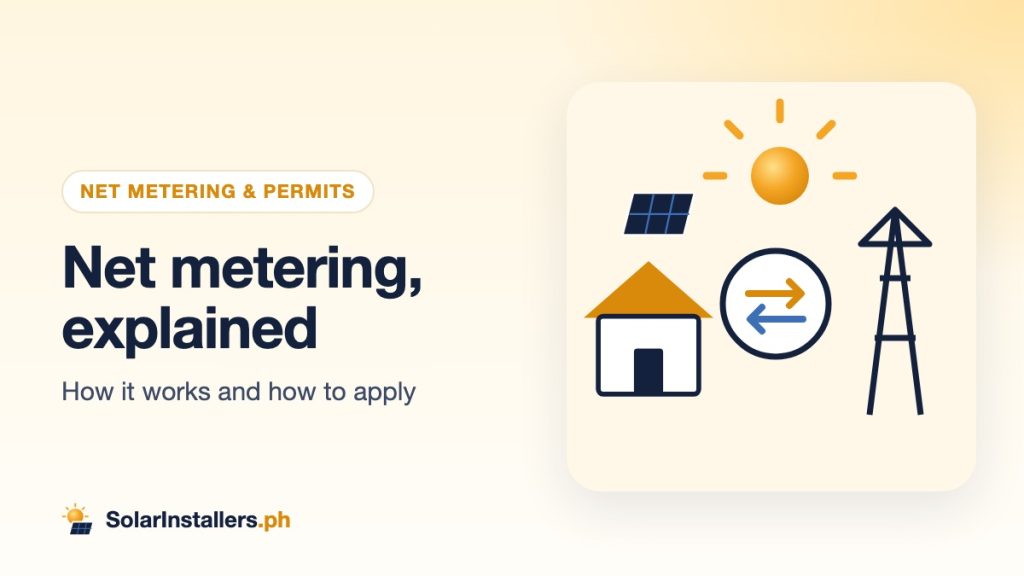
- During the day, your solar panels power your home first.
- When your panels make more than you are using, the extra flows out to the grid.
- A bidirectional meter records both the power you buy and the power you export.
- Each month, your utility subtracts a credit for the exported energy from your bill.
At night or on cloudy days, you simply draw power from the grid as usual.
How exported power is credited
This is the part most people get wrong. Exported energy is not credited at your full electricity rate. According to Meralco, it earns a peso credit based on the utility’s monthly blended generation cost, which is lower than the retail rate and changes every month. Unused credits are carried forward to later bills — they are not paid out in cash.
That has a practical consequence: solar you use yourself is worth more than solar you export. With Meralco’s residential rate at about ₱15.55 per kWh in November 2026, every kWh you use directly saves the full rate, while every kWh you export earns only the generation-cost credit. Homes that use more power during the day — or that add a battery — save the most.
Who can apply
- Net metering is available under the Renewable Energy Act of 2008 (RA 9513) and the Energy Regulatory Commission’s net metering rules, last amended in 2025.
- Systems of up to 100 kW qualify. That covers practically every home and most small businesses.
- Your utility may approve a smaller system than you ask for if the transformer serving your street has limited capacity. Meralco publishes indicative capacity per transformer — for example, around 7 kW on a 10–15 kVA transformer.
How to apply with Meralco: the 6 steps
- Application. Submit the application form and required documents.
- Evaluation. Meralco runs a Distribution Impact Study (and an asset study if needed).
- Inspection. Your installation is inspected, including the LGU permits and the Certificate of Final Electrical Inspection (CFEI).
- Completion. You sign the Net Metering Agreement and pay the fees.
- Energization. Meralco installs and tests the bidirectional meter.
- ERC transmittal. Meralco sends your papers to the ERC for the Certificate of Compliance.
Most solar installers prepare and file the paperwork for you. Ask whether this is included in your quote.
Documents and fees
Under an ERC advisory from September 2025, applications need only four documents:
- the net metering application form,
- the CFEI from your city or municipality,
- the signed net metering agreement, and
- proof of payment of the Certificate of Compliance fee.
Notarization is no longer required and e-signatures are accepted.
| Cost | Amount |
|---|---|
| ERC Certificate of Compliance fee | ₱1,500 |
| Bidirectional meter (cost difference, residential) | Up to ₱3,000 |
| Meralco application, impact study, testing and commissioning | No charge |
| LGU building/electrical permits and CFEI | Varies by city |
How long it takes
In April 2026, under the national energy emergency, the Department of Energy ordered distribution utilities to process net metering applications within 10 working days, and LGUs to act on related permits within 3 working days. That rule applies while the emergency is in effect. In practice, some homeowners still report much longer waits, so ask installers how long their recent approvals in your area took.
Meralco notes that approval depends on your documents and the technical study, so there is no single guaranteed completion date.
Outside Meralco areas
Net metering is a national program, so other distribution utilities and electric cooperatives offer it too, under the same ERC rules. Their forms and timelines differ — your installer or the utility’s customer service can tell you what they require.
Frequently asked questions
Do I need net metering to install solar?
No, but without it you can’t get credit for the power you export. A system without net metering is usually set up as “zero export”, which wastes surplus daytime power unless you have batteries.
Can I apply for net metering with a hybrid system?
Yes. Hybrid systems with batteries can also be connected under net metering.
Will net metering make my bill zero?
Rarely. Because exports are credited below the retail rate, and you still buy power at night, most homes see a large reduction rather than a zero bill.
Want to see what solar could save you? Try our solar calculator, read the solar price guide, or get up to 3 free quotes from installers who handle net metering applications.
Sources: Meralco net metering and application pages (viewed November 2026); ERC Resolution No. 15, Series of 2025, as reported by GMA News (September 2025); ERC advisory on meter costs and documents (September 2025); DOE 10-day processing directive as reported by BusinessMirror (April 2026); Meralco November 2026 rate as reported by Philstar (14 November 2026).