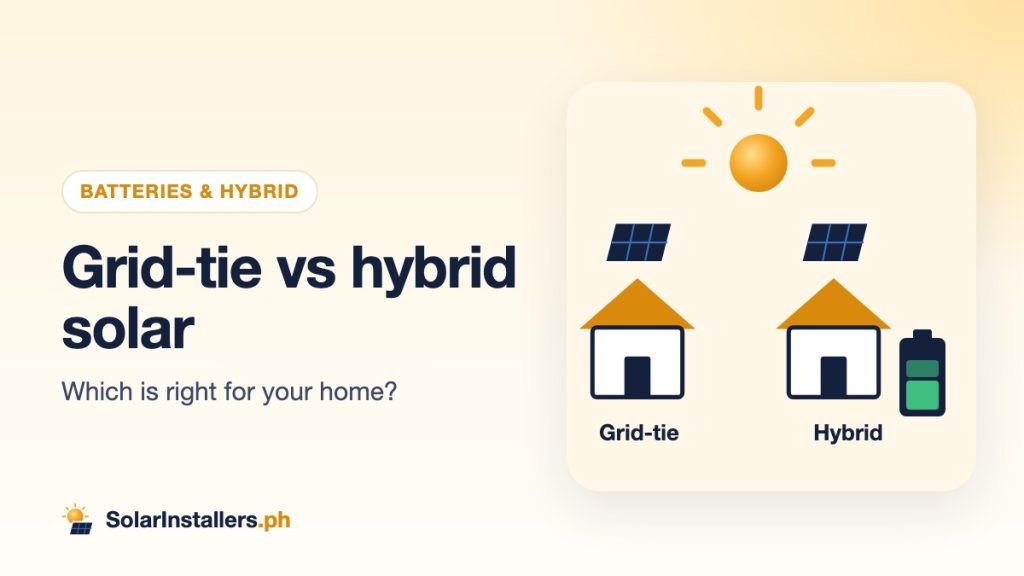
The first big decision when going solar is whether to get a grid-tie system (no batteries) or a hybrid system (with batteries). Both cut your electric bill. The difference is what happens at night and during brownouts — and how much you pay up front.
The short answer
- Choose grid-tie if brownouts are rare where you live, you’re home or running appliances during the day, and you want the lowest cost and fastest payback.
- Choose hybrid if brownouts are common, you need backup power for essentials, or most of your electricity use is in the evening.
Grid-tie: how it works
A grid-tie system has panels and an inverter connected to your home and the utility grid. Your home uses solar power first, and extra power goes to the grid for net metering credits. At night, you buy power from the grid as usual.
Important: a grid-tie system shuts off automatically during a brownout. This is a safety requirement so it doesn’t send power into lines that line workers may be repairing. So a grid-tie system alone does not give you backup power, even on a sunny day.
Hybrid: how it works
A hybrid system adds a battery and a hybrid inverter. Solar charges the battery during the day; in the evening, your home runs on the stored energy before drawing from the grid. During a brownout, the system switches to battery power for the circuits it’s wired to back up.
Because you use more of your own solar instead of exporting it, a hybrid system gets more value from each kWh. That matters in the Philippines, where exported power is credited at the utility’s generation cost — lower than the retail rate you pay.
Cost comparison (2026)
| System | Typical installed price |
|---|---|
| 5 kWp grid-tie | ₱230,000–₱300,000 |
| 5 kWp hybrid with about 10–16 kWh lithium battery | ₱300,000–₱450,000 |
Many 2026 hybrid packages use a single 16 kWh lithium (LiFePO4) battery. Battery pricing varies widely: budget installers sell extra modules for as little as about ₱7,000 per kWh, while full-service companies that include permits and premium equipment work out closer to ₱25,000–₱30,000 per kWh once the hybrid inverter is counted. See our solar price guide for details.
Side by side
| Grid-tie | Hybrid | |
|---|---|---|
| Power during brownouts | No | Yes, for backed-up circuits |
| Uses solar at night | No | Yes, from the battery |
| Up-front cost | Lower | Higher |
| Payback | Usually faster | Usually slower |
| Maintenance | Minimal | Battery has a limited lifespan and warranty |
| Net metering | Yes | Yes |
How big a battery do you need?
- List what must run during a brownout — for example the refrigerator, lights, Wi-Fi, fans and phone chargers. Aircon and water heaters drain batteries quickly.
- Estimate how many hours of backup you want.
- Multiply the power of those loads by the hours. A home running about 500 watts of essentials for 8 hours needs roughly 4 kWh, plus a margin because batteries shouldn’t be fully drained.
If you also want to run most of your evening usage from solar, size the battery to your typical evening kWh instead. A good installer will do this calculation from your bill and your list of appliances.
Can I start with grid-tie and add batteries later?
Sometimes. If you think you’ll want batteries, ask for a hybrid-ready inverter now. Replacing a standard grid-tie inverter later costs more than choosing the right one at the start.
What about off-grid?
Off-grid systems have no grid connection at all and rely entirely on panels and batteries. They make sense for farms, resorts and homes far from power lines, but cost the most because they need large batteries and often a generator backup.
Not sure which fits your home? Use the solar calculator to compare grid-tie and hybrid for your bill, then get up to 3 free quotes — installers can recommend the right setup after a site visit.
Prices compiled from Philippine installers’ published packages, November 2026. Net metering crediting per Meralco’s net metering page.