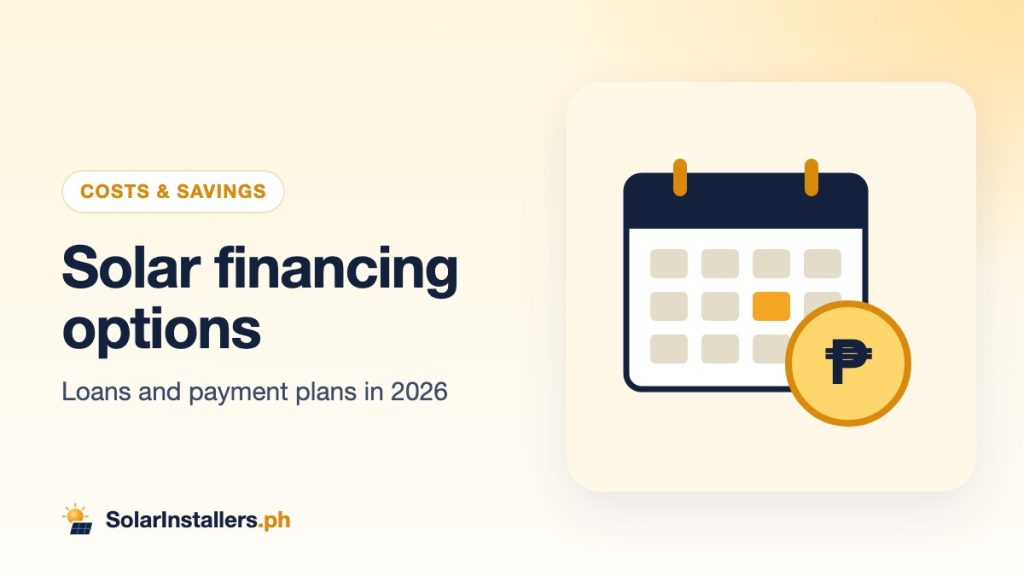
A typical home solar system costs ₱150,000 to ₱450,000, which is a lot to pay at once. The good news: there are now several ways to spread the cost. Here are the solar financing options available in the Philippines in 2026.
GSIS Ginhawa Solar Energy Loan
For government employees and, since September 2026, GSIS pensioners.
- Loan amount: up to ₱500,000
- Interest: 5% a year
- Term: 5 years (60 monthly payments — about ₱10,417 a month for the full ₱500,000, as reported)
- Extras: no service fee, and 3 years of free insurance on the installation
- Who can apply: active members with at least 3 years of service, and pensioners
- How to apply: through the GSIS Touch app
Check the latest terms with GSIS before applying.
Bank financing: BPI Solar Mortgage
BPI offers solar financing for existing customers:
- Top-Up Equity Loan: from ₱400,000, payable over 1 to 20 years, for borrowers who have already paid at least ₱400,000 on a BPI housing loan.
- Multi-Purpose Loan using your car as collateral: from ₱200,000, payable over 1 to 5 years.
You’ll need a quotation from a solar provider. BPI doesn’t publish its rates on the page, so ask the bank for current terms.
Pag-IBIG housing loans
Pag-IBIG has said members can use housing loans for the purchase or installation of solar panels. There isn’t a separate solar loan product, so ask Pag-IBIG how this applies to your situation.
Installer payment plans
Many installers offer their own options:
- Rent-to-own: some providers offer zero-down plans over 60 months — for example, Solviva Energy lists a 5 kWp grid-tie system from about ₱7,736 a month.
- Installments: smaller installers often accept staggered payments, such as a down payment, a payment on delivery and a final payment after energization.
- Cash discounts: some installers give a discount for full cash payment.
Always compare the total amount you’ll pay over the full term, not just the monthly amount.
Does financing still save you money?
Often, yes. If your monthly loan payment is close to what solar saves on your bill, the system effectively pays for itself while you repay it — and after the loan ends, the savings are yours for the rest of the system’s 25-year life. Use our solar calculator to estimate your monthly savings, then compare that with the loan payment.
Tips before you borrow
- Get the installer’s itemized quote first; lenders usually require it.
- Make sure the quote includes permits and net metering so there are no surprise costs.
- Ask whether the installer’s warranty and after-sales service continue regardless of how you pay.
- Don’t over-size the system just because the loan allows it — size it to your actual usage.
Ready for quotes you can take to your lender? Get up to 3 free quotes from installers near you.
Sources: GSIS loan terms as reported by GMA News (March 2026) and Daily Tribune (September 2026); BPI Solar Mortgage page (viewed November 2026); Pag-IBIG statement as reported by Daily Tribune (December 2025); Solviva Energy website (viewed November 2026). Terms change — confirm with each provider.
Category: Costs & savings